
Dubai Metro Gold Line
The Dubai Metro Gold Line was approved on 22 April 2026 and is due to open on 9 September 2032: 42 km of tunnel, 18 stations and AED 34 billion, running from Al Ghubaiba to Jumeirah Golf Estates. It is the first Dubai Metro line planned entirely underground, and it crosses the city through Business Bay and Meydan instead of following the Sheikh Zayed Road corridor the Red Line already covers.
Where the Dubai Metro Gold Line runs
Al Ghubaiba is the northern end. From there the Gold Line heads inland under Business Bay and Meydan, swings out through Al Barsha South and Jumeirah Village Circle, and finishes at Jumeirah Golf Estates. That is a diagonal across the middle of the city, cutting through districts the two open lines pass either side of.
Both ends already exist as stations. Al Ghubaiba is on the Green Line and Jumeirah Golf Estates sits on Route 2020 of the Red Line, and Business Bay is a Red Line stop as well. RTA has not published which of those become physical interchanges or how the platforms connect, so the announcement gives the corridor rather than a wiring diagram.
Eighteen stations across 42 km averages one station every 2.3 km, wider than the Red Line, which fits 35 stations into 67 km. The stations open now give a fair idea of what that feels like in practice: a stop every two or three minutes of running time.
| Point on the route | Rail there today | What the Gold Line adds |
|---|---|---|
| Al Ghubaiba | Green Line | The northern terminus of the new line |
| Business Bay | Red Line | A second line through the Downtown edge |
| Meydan | None | First rail connection |
| Al Barsha South and Jumeirah Village Circle | None | First rail connection |
| Jumeirah Golf Estates | Red Line, Route 2020 | The southern terminus of the new line |
Corridor named in the Dubai Media Office release of 22 April 2026. Station names have not been published.
Why the Gold Line is entirely underground
Every metre of the 42 km runs in tunnel. Nothing else on the Dubai network comes close: the Red and Green Lines are mostly viaduct, with a short tunnelled stretch through the older districts, and the Blue Line puts five of its 14 stations underground.
The price follows from the tunnelling. AED 34 billion over 42 km works out at roughly AED 810 million a kilometre, against about AED 600 million a kilometre for the mostly elevated Blue Line. The route it buys, straight under Business Bay, Meydan and Jumeirah Village Circle, is one no viaduct could take without demolishing a good part of what is already built there.
There is a second consequence worth noting. A tunnelled alignment does not have to follow a road corridor, so the line can sit directly under Business Bay, Meydan and Jumeirah Village Circle rather than skirting them on a viaduct above the nearest highway.
The areas that gain rail for the first time
Meydan, Al Barsha South and Jumeirah Village Circle have no station within walking distance today. Residents there use feeder buses, taxis or their own cars to reach the Red Line, and JVC in particular has grown into one of the densest residential areas in Dubai with no rail at all.
The line also gives the older districts around Al Ghubaiba a route south that does not pass through Union or BurJuman. Those two interchanges carry more riders than any other stations on the network, so a second path across the middle of the city takes pressure off both.
For anyone planning trips before 2032, the route planner works on the network as it stands, using the current timetable rather than projected lines.
Gold Line and Gold Class are not the same thing
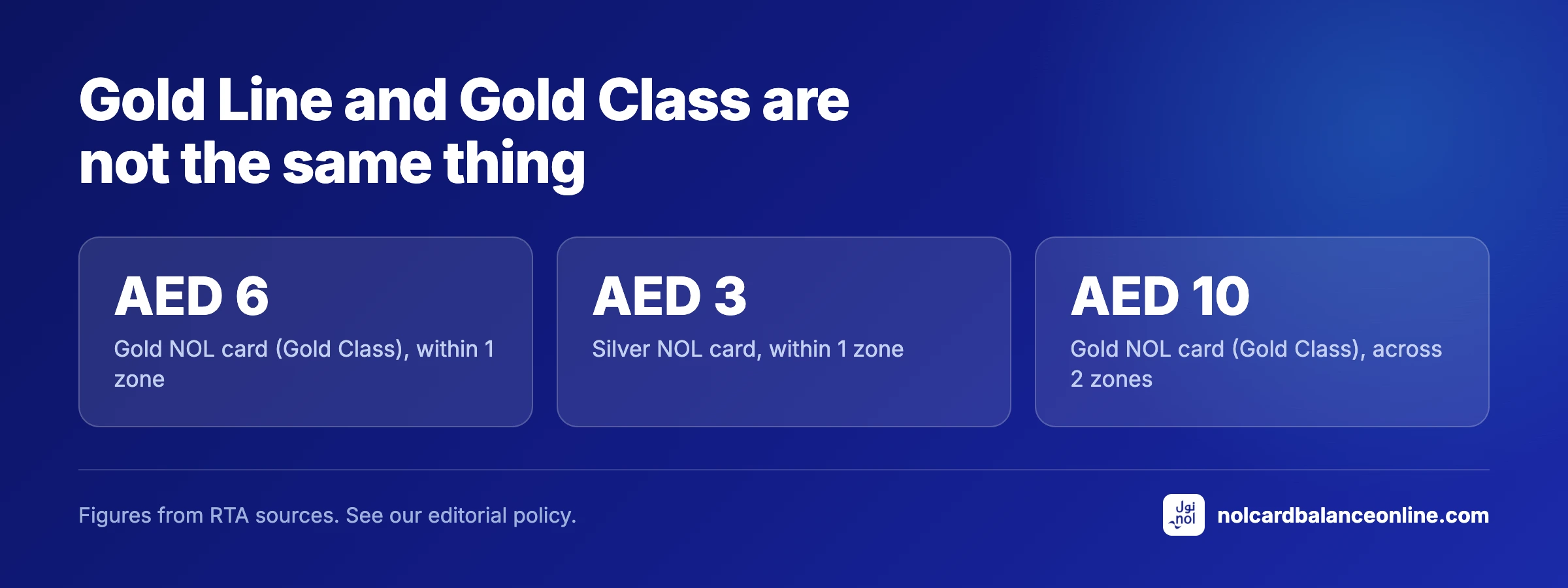
The Gold Line is a route. Gold Class is the front cabin on trains already running, with leather seats and its own section of the platform, and it costs double the standard fare: AED 6 inside one zone against AED 3 on a Silver card, AED 10 across two zones and AED 15 beyond that.
A Gold NOL card is what gets you into that cabin, and it charges the premium on metro and tram every time you tap, seat free or not. On a bus it drops back to the Silver rate. Gold Class is covered in full here, including where the cabin sits on the platform.
Nothing announced so far suggests the Gold Line will have its own fare table. RTA has run one zone based table across metro, tram and bus for years, and the sensible assumption is that the new line joins it.
Gold Line against the Blue Line
Two lines are under way at once, and they do different jobs. The Blue Line reaches east into International City, Mirdif and Al Warqa, areas that run on buses today. The Gold Line runs south west through the middle of the map, linking districts that grew up between the two existing lines.
The Blue Line opens three years earlier, in 2029, and costs about half as much for two thirds of the distance. Both dates fall on 9 September, the anniversary RTA has used for every metro opening since 2009.
| Blue Line | Gold Line | |
|---|---|---|
| Approved | Under construction | 22 April 2026 |
| Opens | 9 September 2029 | 9 September 2032 |
| Length | 30 km | 42 km |
| Stations | 14 | 18 |
| Underground | 5 of 14 stations | All of it |
| Cost | AED 18 billion | AED 34 billion |
RTA and Dubai Media Office figures, April 2026 and December 2025.
What has not been published yet
Six years out, the Gold Line is a corridor, a station count and a budget. There is no station name list, no interchange plan, no zone allocation and no fare. Any site giving you 18 station names for the Gold Line today has made them up, and the same goes for journey times.
The one number worth watching is the opening date. RTA held its date on the Red Line and has held it so far on the Blue Line, which is a decent record, though a project approved in 2026 for delivery in 2032 has plenty of room to move. This page carries the figures from the approval release and gets updated when RTA adds to them.
Keep reading
NOL Card Balance Check Online 2026: RTA Dubai
Check your NOL card balance with the 10 digit tag ID, then open the official RTA page. Minimum balance AED 7.50, every method, updated August 2026.
NOL Fare Calculator 2026: Dubai Metro, Bus, Tram
Work out any Dubai Metro, bus or tram fare by zone and card type: Silver AED 3 to 7.50, Gold double, Red Ticket, concessions. Updated August 2026.
NOL Card and Dubai Metro Questions and Answers
Straight answers on NOL balance checks, tag IDs, fares, zones, passes, refunds, lost cards, expiry and how our calculators are tested against RTA.
Frequently asked questions
When was the Dubai Metro Gold Line approved?
On 22 April 2026, announced through the Dubai Media Office. Construction is planned to finish for a 9 September 2032 opening.
How long is the Gold Line and how many stations does it have?
42 km with 18 stations, all of it underground. That makes it longer than the Green Line and the Blue Line, and the most expensive metro line Dubai has approved at AED 34 billion.
Where does the Dubai Metro Gold Line run?
From Al Ghubaiba in the north to Jumeirah Golf Estates in the south, by way of Business Bay, Meydan, Al Barsha South and Jumeirah Village Circle.
Is the Gold Line the same as Gold Class?
No. Gold Class is the premium cabin at the front of trains running today, at double the standard fare. The Gold Line is a route due in 2032. A Gold NOL card gets you into the cabin, not onto a particular line.
What will a Gold Line fare cost?
RTA has published no fares for the line. Everything else on the network charges by zone, AED 3 to AED 7.50 on a Silver card, and there is no announcement of a separate table for the Gold Line.
Will the Gold Line serve Dubai Marina?
Not directly. The southern end is at Jumeirah Golf Estates, inland from the Marina. The Marina keeps its Red Line stations and the tram.
Which line opens first, Blue or Gold?
Blue, on 9 September 2029, three years before the Gold Line. The two projects run in parallel and cover opposite sides of the city.