
Dubai Metro Zones Explained
Dubai Metro zones are the whole basis of the fare: RTA divides the emirate into seven of them, and a trip costs AED 3, AED 5 or AED 7.50 depending on how many it touches. Only four zones contain a rail station, which makes the system simpler than the number seven suggests. Distance never enters the calculation.
Seven zones, four with a metro station
Zones 1, 2, 5 and 6 are the ones a metro or tram rider will ever see. Zone 5 covers Deira, Al Qusais, Al Rashidiya and both Dubai International terminals with stations. Zone 6 runs from Bur Dubai through Zabeel, Trade Centre and Downtown to Business Bay and out to Al Jaddaf. Zone 2 stretches from Al Safa along Sheikh Zayed Road to Jebel Ali and takes in Mall of the Emirates, Dubai Internet City, the Marina and all 11 tram stops. Zone 1 is the far south west: Danube, Life Pharmacy, Jumeirah Golf Estates, Dubai Investment Park and Expo 2020.
Zones 3, 4 and 7 exist on the same fare map and carry buses only. Zone 3 covers the inland belt around Al Barsha South and Hadaeq Mohammed bin Rashid, Zone 4 takes in Ras Al Khor, Mirdif, Al Warqa and Warsan, and Zone 7 reaches the outer south east. No station stands in any of them today, though the Blue Line will change that for Zone 4 in 2029.
Zones connect in a chain rather than a grid: 5 touches 6, 6 touches 2, and 2 touches 1. That chain is what makes centrepoint to Expo 2020 a top tier fare, because the path runs through zones 5, 6, 2 and 1 in order. Look up any station's zone here. The chain also explains why no metro trip can ever touch more than four zones: the network simply does not reach far enough across the map. The metro map page pairs this with the full network view and RTA's official PDF.
How zones crossed set the fare
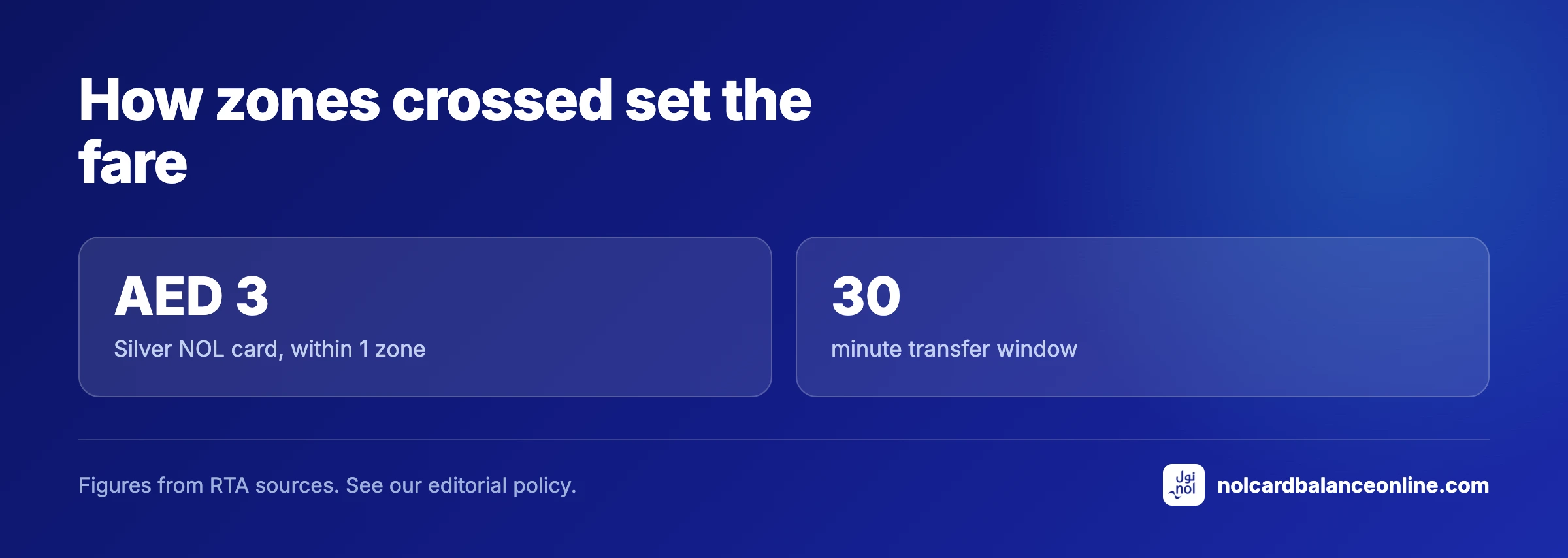
The gate counts distinct zones on your path, then charges the matching tier: one zone, two adjacent zones, or more than two. A journey that starts and ends in Zone 2 costs AED 3 on a Silver card no matter how many stops it covers, so Mall of the Emirates to Ibn Battuta, nine stops apart, is a one zone fare.
A line change adds nothing by itself. Creek to Business Bay means a Green Line ride, a change at BurJuman and a Red Line ride, but every station on that path sits in Zone 6, so the fare stays at AED 3. What matters is the set of zones touched, not the number of trains.
The same table applies across metro, tram and bus, so a metro leg plus a bus leg is priced on the combined zones as long as the second tap happens within 30 minutes of the first check out. The full fare breakdown covers the transfer limits and the card by card prices.
The boundary stations that catch people out
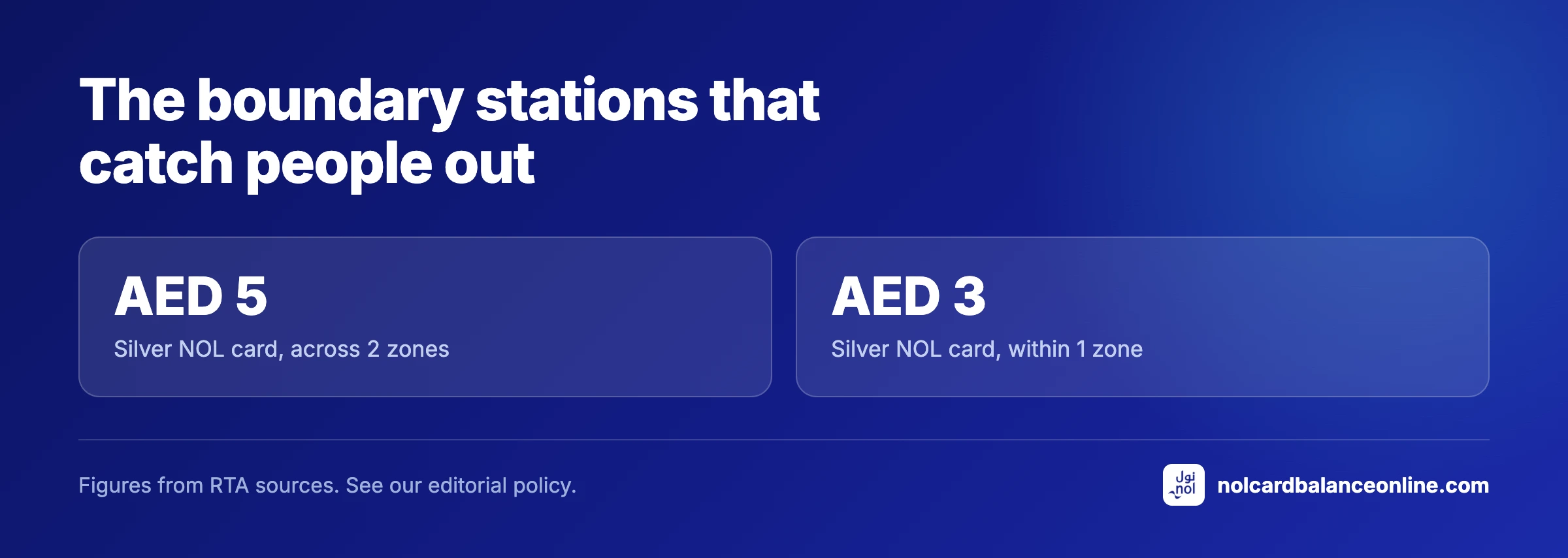
The creek separates Zone 5 from Zone 6, and the December 2025 map draws Union on the Deira side and BurJuman on the Bur Dubai side. One stop on the Red Line between them crosses a zone, so a trip that looks trivial costs AED 5 rather than AED 3. Al Ghubaiba on the Green Line sits in Zone 6 for the same reason.
Danube and Jumeirah Golf Estates are drawn on the line between zones 1 and 2. When one of them is the start or the end of a journey it takes whichever of its two zones gives the lower count, and in the middle of a path it adds nothing at all. That treatment matches how the gates behave, though RTA has never published it in writing.
The pattern to watch is short trips near a boundary. Business Bay to ONPASSIVE is two stops but crosses from Zone 6 into Zone 2. Al Ras to Al Ghubaiba is one stop under the creek and crosses from 5 into 6. Neither feels like a long journey, and both are charged as two zones.
Worked examples on real routes
The quickest way to understand the system is to price a few journeys people actually make. Each row below counts the distinct zones on the shortest path and applies the Silver card fare.
Mall of the Emirates to Burj Khalifa and Dubai Mall is the question we get asked most. Mall of the Emirates is in Zone 2 and Dubai Mall is in Zone 6, two adjacent zones, so it costs AED 5 each way even though the ride is four stops and about 14 minutes.
The table also shows why the top tier is rare on this network. Only a journey that runs the length of the Red Line, or one that pairs the far south west with Deira, touches more than two zones. Most riders spend their whole week paying AED 3 or AED 5, and the AED 7.50 tier shows up on an Expo trip or an airport run from the Marina.
| Journey | Zones touched | Tier | Silver fare |
|---|---|---|---|
| Mall of the Emirates to Burj Khalifa and Dubai Mall | 2 and 6 | 2 adjacent zones | AED 5 |
| Airport Terminal 3 to Burj Khalifa and Dubai Mall | 5 and 6 | 2 adjacent zones | AED 5 |
| Union to BurJuman | 5 and 6 | 2 adjacent zones | AED 5 |
| Mall of the Emirates to Ibn Battuta | 2 only | Within 1 zone | AED 3 |
| Creek to Business Bay via BurJuman | 6 only | Within 1 zone | AED 3 |
| centrepoint to Expo 2020 | 5, 6, 2 and 1 | More than 2 zones | AED 7.50 |
Zones read from the RTA rail network map of December 2025; fares from RTA nol Fares.
How to buy a pass by zone
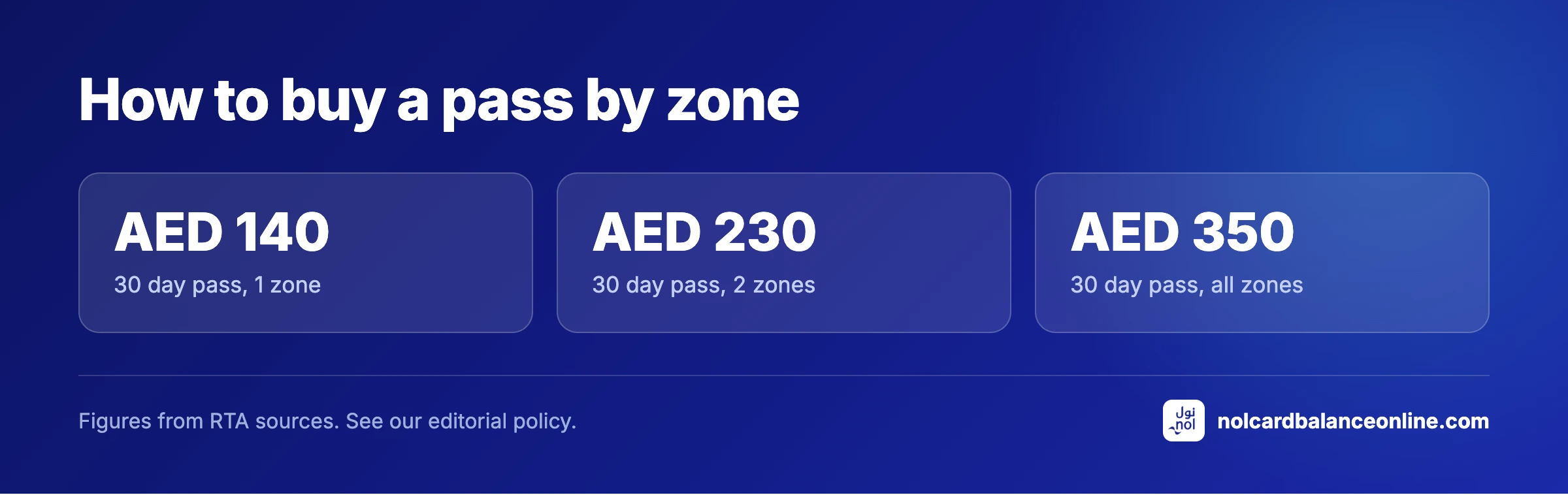
Travel passes are sold by zone coverage as well as by length. A 30 day pass costs AED 140 for one zone, AED 230 for two and AED 350 for all zones on a Silver card. Any leg outside the zones your pass covers is charged at the normal single fare on top, so a Marina resident with a one zone pass still pays to reach Deira.
The scope you pick is the whole decision. A commute that stays inside Zone 2, say Dubai Internet City to DMCC, needs the one zone pass at AED 140. A commute from the Marina to Downtown crosses into Zone 6 and needs the two zone version at AED 230. The pass calculator compares that against paying per trip.
An anonymous Silver or Gold card can hold the 7 day pass only, at AED 50 to AED 110. The 30, 90 and 365 day passes need a registered or Blue Personal card, so the first move for a commuter is usually registration rather than a bigger top up. The Silver card page covers what registration changes.
Where the zone system is guesswork
RTA publishes no station to zone table. Every zone quoted on this site is read from the shading on the official rail network map of December 2025, which is a drawing, not a database. For most stations that is unambiguous. For Union, BurJuman and Al Ghubaiba it is a judgement about which side of the creek a symbol sits on, and older references list some of those stations in two zones at once.
The practical effect is small but real: a boundary call is the difference between AED 3 and AED 5 on a short trip. If you tap a route through one of those stations and the deduction does not match what we show, the gate is right and our reading of the map is wrong. Tell us and we will correct it.
Keep reading
NOL Card Balance Check Online 2026: RTA Dubai
Check your NOL card balance with the 10 digit tag ID, then open the official RTA page. Minimum balance AED 7.50, every method, updated August 2026.
NOL Fare Calculator 2026: Dubai Metro, Bus, Tram
Work out any Dubai Metro, bus or tram fare by zone and card type: Silver AED 3 to 7.50, Gold double, Red Ticket, concessions. Updated August 2026.
NOL Card and Dubai Metro Questions and Answers
Straight answers on NOL balance checks, tag IDs, fares, zones, passes, refunds, lost cards, expiry and how our calculators are tested against RTA.
Frequently asked questions
How many zones does Dubai Metro have?
RTA operates seven fare zones across the emirate, but metro and tram stations fall inside only four of them: 1, 2, 5 and 6. Zones 3, 4 and 7 are served by buses alone, so no rail fare ever involves them.
Why is Mall of the Emirates to Dubai Mall two zones?
Mall of the Emirates sits in Zone 2 and Burj Khalifa and Dubai Mall sits in Zone 6, and the two are adjacent. The fare counts the zones touched rather than the four stops between them, so the trip costs AED 5 on a Silver card.
Which zone is Dubai Marina in?
Zone 2, along with Sobha Realty, DMCC, Ibn Battuta, Mall of the Emirates and every one of the 11 tram stops. A ride anywhere inside that zone costs AED 3 on a Silver card.
Is Union in Zone 5 or Zone 6?
Zone 5 on the current RTA map, on the Deira side of the creek. BurJuman, one stop south on the Red Line, is in Zone 6, which is why the shortest possible interchange trip is still a two zone fare.
Does changing lines cost extra?
No. A change at Union or BurJuman happens inside the paid area and adds no zone by itself. Creek to Business Bay involves a change and still costs AED 3, because every station on that path is in Zone 6.
Which zone is Expo City in?
Zone 1, along with Dubai Investment Park, Jumeirah Golf Estates, Life Pharmacy and Danube. A trip there from Deira or the airport crosses four zones and lands in the top tier at AED 7.50.
Do bus fares use the same zones?
Yes, buses use the same seven zones and the same three tier table, which is how zones 3, 4 and 7 come into play. Route 110 is the exception at a flat AED 2 regardless of zones.